
Winter Storm Threatens Appalachian NatGas With ‘Freeze Offs’ As Data Center Demand Tightens PJM Grid

Submitted by Criterion Research President James Bevan,
An incoming winter ice storm is poised to crimp Appalachian natural gas production at a critical moment when the power grid faces mounting pressure from surging data center demand and extreme cold.
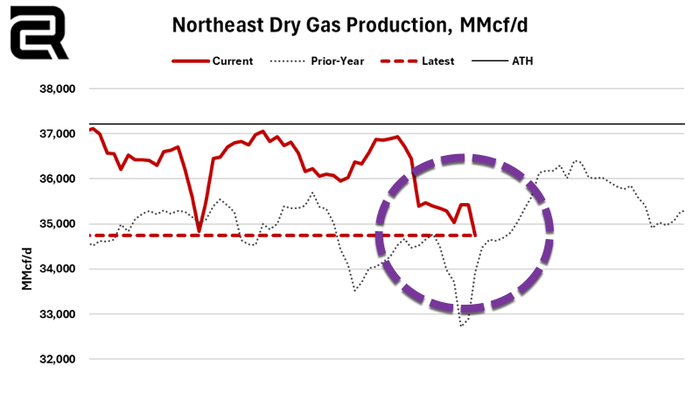
Appalachian volumes already plummeted 682/d to 34,745 MMcf/d as the ongoing cold snap hit supply. The region is down 2,189 MMcf/d versus recent two-week highs.
Freeze-offs are already taking effect, with Pittsburgh projected to experience overnight lows near 0°F by January 27.
Winter is Coming for Appalachia
This week’s Appalachian nat gas production is already down 1.1 Bcf/d versus last week, and the extreme cold is just getting started.Pittsburgh overnight lows are headed to -6.8°F at their most intense levels next week, with this cold coming in… pic.twitter.com/l2oyl80cfe
— Criterion Research (@PipelineFlows) January 22, 2026
The Moisture Problem
The critical difference between ice storms and snow is moisture. Freezing rain, sleet, and ice create wet conditions that prove far more problematic than dry snow. For the Northeast pipeline system, ice and sleet storms pose significantly higher risks to sustained gas production compared to snow events.
Freezing liquid accumulation causes multiple failure modes: frozen dump valves block separators and pneumatic controls, ice accumulation damages exposed infrastructure and above-ground systems, rapid freezing exacerbates blockages and underground damage, and operational shutdowns from structural failures account for substantial cold-weather incidents. Internal freeze-offs—when ice freezes on valves and equipment—obstruct gas flow throughout the system.
NOAA’s latest forecast shows freezing rain concentrations from Texas to the Carolinas, with six-inch snowfall probabilities concentrated in Appalachia. Ice accumulation is expected across the region through January 26.
Grid Stress Mounting
Complicating the supply disruption is explosive demand-side growth from data centers, which have become one of the fastest-growing electricity consumers in the power sector. As AI computing facilities proliferate across the Northeast, winter power demand is spiking precisely when weather threatens production. Preliminary guidance suggests freeze-offs could drop production by 5-8 Bcf/d, with >10-15 Bcf/d possible if infrastructure sustains damage.
PJM observed demand flows are already pointing higher on the Criterion Mapping Analytics Platform – and the cold is only starting to migrate in.
This dual squeeze – compressed supply from weather events and surging electricity demand from data center buildout – is testing the grid’s ability to maintain supply during extreme weather.
The convergence represents a critical vulnerability: production-constrained Appalachia feeding a power system increasingly dependent on digital infrastructure, while winter extremes threaten both simultaneously.
Loading recommendations…
Read the full article here