

Unlock the Editor’s Digest for free
Roula Khalaf, Editor of the FT, selects her favourite stories in this weekly newsletter.
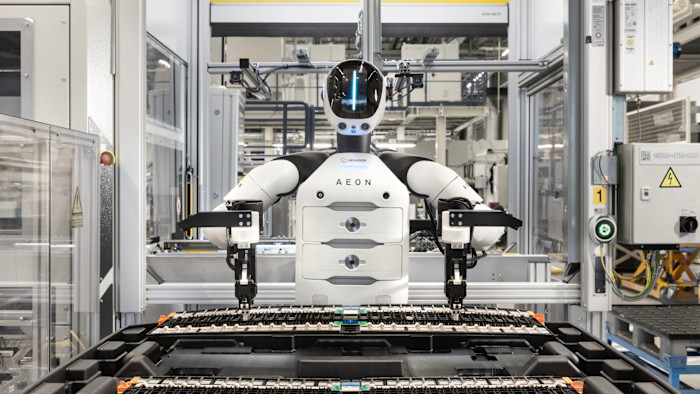
BMW will put humanoids on the factory line at one of its German plants, as Europe’s struggling auto industry turns to AI-powered robots to bring down labour and manufacturing costs.
The pilot at BMW’s plant in Leipzig will be the first time the company has deployed humanoids at one of its European factories following a trial in the US last year.
BMW joins Tesla, Hyundai and a slew of other carmakers that are betting on growth in the humanoid market, which Morgan Stanley estimates could reach $5tn by 2050, led by widespread use in China.
The automotive industry is aiming to use its engineering expertise in robotics as a driver of new revenue as well as bringing down labour costs and boosting productivity.
In Leipzig, a single-digit number of humanoids, supplied by Swedish firm Hexagon, will be used on assembly lines and the manufacture of high-voltage batteries for electric vehicles where employees have to wear cumbersome protective clothing.
The project is similar in scale to a pilot carried out by BMW at its plant in Spartanburg, South Carolina. At the US factory robots placed sheet metal parts for welding used in more than 30,000 vehicles over 10 months, working in 10-hour shifts five days a week, the company said.
The task was “particularly demanding in terms of speed and accuracy while also being physically exhausting” for employees, said BMW.
“Digitalisation improves the competitiveness of our production — here in Europe and worldwide,” said BMW production chief Milan Nedeljković, who will become the company’s chief executive in May.
The project would be launched this year following a test deployment in April, the company said. Adding humanoids to production was a complement to existing plant automation and would help “relieve employees and further improve working conditions”, the company said.
In time, BMW could also take on more tasks currently performed by suppliers using humanoids. “This gives us opportunity to do more production in-house,” said Michael Ströbel, BMW’s head of process management.
The auto industry has increasingly looked to humanoids as a way to upgrade its factories and as a potential new market for its products.
Hyundai is testing the use of humanoids in its factories, with its robotics unit Boston Dynamics this year revealing a new version of its humanoid designed to work in the company’s production plants from 2028.
Toyota also announced last week that it would use humanoids at a plant in Canada.
Mercedes-Benz last year began using humanoids to transport materials on the factory floor and carry out quality checks in its Berlin plant. Ford has also tested humanoids at its Cologne site.
For auto suppliers, whose traditional markets have shrunk in the face of cheap Chinese competition and weak demand, robotics presents another field where their expertise in precision engineering can be redeployed.
Parts-maker Schaeffler has signed agreements with humanoid start-ups including Germany’s Neura Robotics and Britain’s Humanoid to purchase hundreds of robots and supply components for the machines.
Read the full article here