

Unlock the Editor’s Digest for free
Roula Khalaf, Editor of the FT, selects her favourite stories in this weekly newsletter.
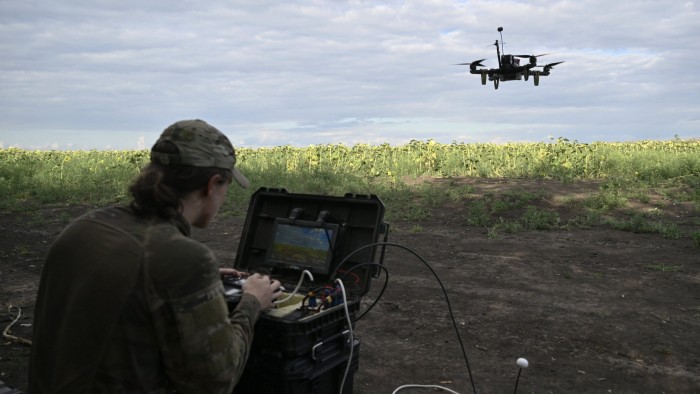
The EU is rushing to spend billions on setting up a “drone wall” with technology that has been battle-tested in Ukraine, after Russia’s recent forays into Nato’s airspace.
Last week’s response to the Russian aerial incursions into Poland and Romania showed Nato relies on expensive technology to intercept relatively cheap drones — a glaring vulnerability Moscow can exploit further. To fill the gap, Brussels has encouraged capitals to use EU funds and jointly purchase systems that have worked in Ukraine.
Hours after Nato jets shot down a few of the estimated 19 drones that entered Poland’s airspace, European Commission president Ursula von der Leyen said Europe had to “build a drone wall” on its eastern border. She said this would be “a European capability developed together, deployed together, and sustained together, that can respond in real time”.
The EU will also set up a “drone alliance” with Kyiv, backed by €6bn in financing to “transform Ukrainian ingenuity into battlefield advantage and into joint industrialisation”, von der Leyen said.
Poland, the Baltic states and Finland — the EU states bordering Russia — have all announced plans to reinforce their frontiers, but officials warn the approach will only be effective if it is unified and built on common and fully-integrated technologies.
One of the EU officials said: “Europe’s defence posture is too fragmented, but this particular area is where we really need to see much more co-ordination.”
“You can’t have one [frontline] state doing one thing on their border and another doing something different,” the official added. “Russia will just tailor their approach to our weaknesses.”
Nato’s eastern flank members are set to receive nearly €100bn in defence-related loans, out of a total of €150bn raised against the EU’s shared budget.
The Security Action for Europe loans “will help” with the drone wall initiative, commission spokesperson Thomas Regnier said on Tuesday, “if member states want to have a common approach to protect the EU”.
Daniela Hildenbrand, head of anti-drone solutions at the German defence contractor Hensoldt, said the region was getting “a bit more creative in contractual arrangements to make sure we have an overall protective shield for Europe and Nato”.
“This means exploring how member states can have multinational frameworks or help each other out with capability,” she said.
To plug the gap while new defence systems are acquired, Nato has launched an air defence mission — Eastern Sentry — that involves fighter jets, ships and reconnaissance systems deployed along the eastern flank, from Finland to Bulgaria.
“We’re not ready,” said Max Enders, head of business development at the Munich-based start up Tytan, which makes drone interceptors that are in use on Ukraine’s frontline. “There’s a whole category of threats that Europe is currently struggling to defend itself against.”
Enders described the conflict with Russia as a “war of iteration”, in which both sides perfect their unmanned aerial vehicles and interceptors capable to shoot them down.
Ukraine has innovated in air defence from the start of the full-scale invasion in 2022. While Kyiv relies on western partners for air defence systems to shoot down missiles, it has pioneered cost-effective ways of dealing with Russian attack drones.
With standard radar unable to detect small, low-flying Shahed attack drones, Ukrainian tech companies developed a nationwide system of acoustic sensors that could identify them by their sound signature. That intelligence is then fed to hundreds of mobile teams equipped with anti-aircraft cannon and heavy machine guns — a far cheaper solution than using missile interceptors.
President Volodymyr Zelenskyy last week offered Poland training on how to combat Russian drones, particularly Iran-made Shaheds. Warsaw’s defence ministry said “advanced discussions are under way between specialists from both countries concerning deepened co-operation in the area of drone and anti-drone systems”.
Karolis Aleksa, Lithuania’s vice-minister for defence, told the Financial Times the Baltic country was emulating the Ukrainian practice of using mobile combat teams to shoot down drones detected by the acoustic detection system.
It was too costly to use “expensive weaponry such as fighters and missiles. That’s why we’re pushing cheaper and smarter solutions,” he said.
A similar acoustic system is being implemented in Latvia, while Romania is exploring how Ukrainian experience could be factored into their Safe spending.
“The whole concept of drone war has changed the nature of modern armed conflict,” said Brigadier General Markku Viitasaari, director of Finland’s National Defence Unit.
“There certainly is a need to develop new countermeasures especially against unmanned systems. Some options already exist and are in use but new technologies and methods are needed.”
Additional reporting by Marton Dunai in Budapest and Raphael Minder in Warsaw
Read the full article here