

Unlock the Editor’s Digest for free
Roula Khalaf, Editor of the FT, selects her favourite stories in this weekly newsletter.
Germany plans to be the first European power to develop its own space-based missile detection capability, as the continent seeks to cut its reliance on Washington for defence.
The head of the country’s space command, Major General Michael Traut, told the FT that Germany was “now planning to have the core of a satellite-based missile detection system”.
The project would be national “but open of course, to European collaboration”, he said. He insisted that such national capabilities would make Germany and Europe stronger partners for the US.
Europe currently relies on a shared common space-based warning system provided by the US through Nato to spot threats such as long-range missiles. But President Donald Trump’s unpredictable approach to Nato and his recent threats to annex Greenland have alarmed European capitals, sparking a push to increase their sovereign military capabilities.
Germany has been at the forefront of this spending boom. Last year Berlin announced it would invest €35bn in military space technology by 2030 — instantly leaping into the top league of global spenders.
Berlin has already launched a sky shield initiative to build up Europe’s ground-based air and missile defences.
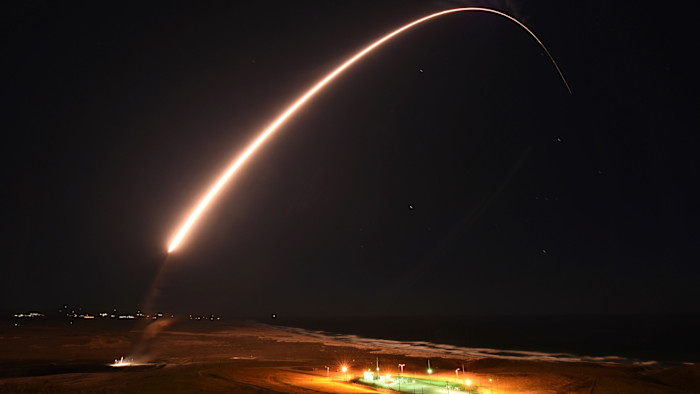
Speaking at the European space conference in Brussels, Traut said missile detection was an operational priority. “Space-based early warning and satellite-based missile detection . . . [is] very urgent because, well, the threat is imminent,” he said.
“Europe has been dependent on the United States . . . more or less in all aspects of space capability,” Traut said. There was “a strong need to build up some German and European sovereign capabilities in missile detection and interception . . . We not only want to be able to detect missiles early, we want to be able to fight them early.”
Berlin’s plan would give Europe its first operational detection capability. France has experimented with launching demonstrator satellites to detect rocket launches before, including the Spirale programme in 2009, but this was not followed up after the mission ended. Germany’s Fraunhofer EMI launched another demonstrator satellite aimed at launch detection in 2024.
Josef Aschbacher, director-general of the European Space Agency, said in a separate interview that the multinational body was “in discussions” over how it could be involved in the future development of missile-detection technology.
“There are continuous meetings between Germany and us, offering the capability of a system architecture to link their capabilities into European infrastructure,” he said. “But all these discussions are just happening, right now.”
Aschbacher reiterated that while dual-use technologies would become an increasingly important focus area for the ESA, the agency would never be involved in offensive weapons development.
ESA has traditionally only worked on civilian space technologies. However, in November, its members, which include EU constituents as well as Canada, Norway and the UK, agreed to fund the agency’s first explicitly dual-use program, to develop technology for a space-based intelligence, surveillance and reconnaissance network.
Aschbacher said he expected dual-use programmes to become an increasingly bigger focus for the agency, which would require a doubling of European collective spending on space by 2030. “You can’t do defence without space,” he said.
The introduction last year by Russia of the Oreshnik ballistic missile, which has been used twice in Ukraine and is considered almost impossible to intercept, has underlined the vulnerability Europe faces in the area of launch detection.
Traut declined to give any details on the timeline or budgets being discussed for the space-based capability. However, he said there was no time for delay.
“Our chief of defence in Germany has given us the order to be ready for war in 2029,” he said. “But in space we need to be ready to fight now if necessary.”
Read the full article here