

The glossy black box opens and a video plays on a screen embedded inside the lid. The stilted voice of former UK prime minister Liz Truss makes its pitch.
“I’m delighted to be part of this exciting new venture in the heart of Mayfair,” says Truss, sitting behind a large microphone in a generically rustic room. “The Leconfield is a nexus of a global network of leaders, of entrepreneurs, of technologists, based in the former MI5 headquarters.”
The lacquer box, emblazoned with a golden crest, has been delivered to chief executives, hedge fund managers and other deep-pocketed potential founder members of the project Truss is fronting for British businessman Robert Tchenguiz.
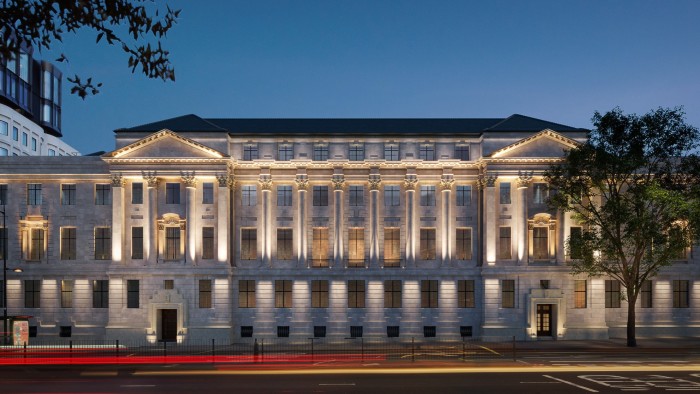
It will be based in Leconfield House on London’s Curzon Street and will have restaurants, a wellness suite and acoustically sealed pods for business meetings.
Just do not call it a club.
Truss, who was Britain’s shortest-lived prime minister, says the C-word “conjures up certain images in people’s minds” of socialising and relaxing. “This is focused on business . . . and that’s kind of the opposite of leisure.”
Truss and Tchenguiz are searching for 700 founder members to put in £500,000 each.
Tchenguiz will use £200mn of the target £350mn to pay off the building’s mortgage, owed to property moguls the Reuben brothers, the Financial Times reported this week.
It will also go towards buying a property in Hampshire which he intends to turn into a “luxurious wellness retreat”. Of the remaining money, £100mn will be for the Leconfield’s fit-out and the rest for working capital and contingency.
The Leconfield is meant for networking across spheres and for making deals, Truss claims in an interview alongside Tchenguiz in his smoky office in the building.
He has long overseen his property and business empire from Leconfield House, which was once searched by the Serious Fraud Office as part of a botched criminal probe, for which he was ultimately awarded £1.5mn in damages, £15mn in legal fees, and received an apology from the SFO.
The timing of the pair’s not-a-club project is counterintuitive after an exodus of London’s wealthiest in the wake of chancellor Rachel Reeves’ 2024 Budget, which raised taxes on them. Some quit their club memberships to ensure all ties to the UK were severed.
Other, more established, rivals have meanwhile suffered. The Soho House group, which comprises 46 clubs, was taken private earlier this year after a long spell of stock underperformance.
Truss and Tchenguiz stress that there will be an artificial intelligence aspect to The Leconfield, to facilitate deals between members by deducing who should work with whom. Tchenguiz, who compares it to ChatGPT but “10 levels higher”, says Truss will “run the AI aspect”.
This seems to be news to Truss. When pressed, Truss talks about AI’s use in building networks, which she also hopes to facilitate in person at The Leconfield.
Tchenguiz is such an enthusiast for ChatGPT that he says he will ask the large language model what he and Truss should do together.
When the FT later tries this, it gives “light-hearted” suggestions (“a premium cheese marketplace” — in reference to Truss’s infamous 2014 defence of British cheese).
Asked whether they should found a membership organisation, the program says it is a good idea “if executed with discipline” and focused on business, not politics.
The AI aspect will be “a modern differentiator”, says the AI, then it asks if it should produce a pitch deck.
The Leconfield is not the only new institution in London to reject the label of a club. Across London is a building belonging to Camden council that has been partially converted by hospitality group Bottaccio into Town Hall, labelled “London’s living room for artists, technologists, and visionaries”.
Alongside events, Town Hall will host The Society, a membership organisation. “It’s not a club, it’s a community,” says Romy Westwood, Town Hall’s membership director. To her, the word suggests tribal Pall Mall’s gentlemen’s clubs and the Soho House chain.
The Society is marketed as something loftier: “There’s a new world of people really wanting to connect with each other in a much more enriching way,” says Westwood.
It seems, in Westwood’s telling, that it won’t be a club, but it won’t not be a club: “We’re not going to down the committee route, it’s too elitist . . . There will be an approval process, it will still be curated to some extent.”
London is a club town, says social historian Seth Alexander Thévoz, with the highest concentration of any major global city. But for at least a century now, he says, “there’s been an image problem, a stuffy old place with faded armchairs.”
That is something that a new generation of clubs is trying to combat. Thévoz’s latest book, London Clubland: A companion for the curious, lists 133 clubs, of which he deems 55 “traditional” and 78 post-1985. “The vast bulk of the new ones are post-2015 or indeed post-2022, and a dozen are being set up right now.”
His theory is not that clubs have become more attractive to members but that there are now more rich people who are willing to invest in them “because they’re labouring under the misapprehension they’re going to make a lot of money. If there’s one way of losing a vast sum of money very quickly, it’s investing in a private members’ club.” He says it has become “fashionable”.
Today’s clubs differ from their forebears in that “these new ones are entirely proprietary, run for profit by a private landlord. For older members-only clubs, they’re run as an autonomous collective, not for profit . . . All these new institutions are very much run for somebody to pay off their mortgage.”
Not all these organisations are allergic to the word “club”. In September 2026, The Pembroke Club will open across 50,000 sq ft at 6-7 Grosvenor Place, next to the billionaire-populated Peninsula hotel and residences on Hyde Park Corner.
The building is owned by the Grosvenor Estate, which belongs to the dukes of Westminster, and Oman’s sovereign wealth fund is paying for the redevelopment.
Other membership organisations are on the fence about nomenclature. Louie Blake, co-founder of Long Lane — which is due to open summer 2026 in West Sussex, about an hour’s travel from London — does not mind “club”, but prefers “a collective of people who prioritise their health and wellbeing”.
The founders claim Long Lane will be the only “wellness-first, alcohol-free” private members’ organisation in the UK. It will offer sound-healing sessions; “biohacked bedrooms” stocked with collagen shots and IV drips. Members and guests can also dine at what Blake describes as “the world’s first precision nutrition restaurant,” which will use biometric data to create personalised menus.
Jamie Caring, a consultant to Long Lane and the son of hospitality magnate Richard Caring, insists that the connotations of members’ clubs are changing and the term is now appropriate for a “really inclusive” venture like Long Lane.
Back in Leconfield House, Tchenguiz seems annoyed as the word “club” keeps coming up. This includes when he is asked to comment on Thévoz’s statistic that the average lifespan of a new London club is three years.
“I don’t want people to think we are competing with Annabel’s and we’re competing with 5 Hertford Street. We’re not competing,” he says emphatically, referring to two Mayfair clubs favoured by society. “We will spend whatever is required to provide the service that a multinational chairman, a chief executive of a hedge fund, a family office with $5bn needs when he’s in London. That does not exist.
“When you compare it to Annabel’s, it’s a whole different model. Annabel’s wants to sell you a pizza.”
Additional reporting by Euan Healy and Julie Steinberg in London
Read the full article here