

Unlock the Editor’s Digest for free
Roula Khalaf, Editor of the FT, selects her favourite stories in this weekly newsletter.
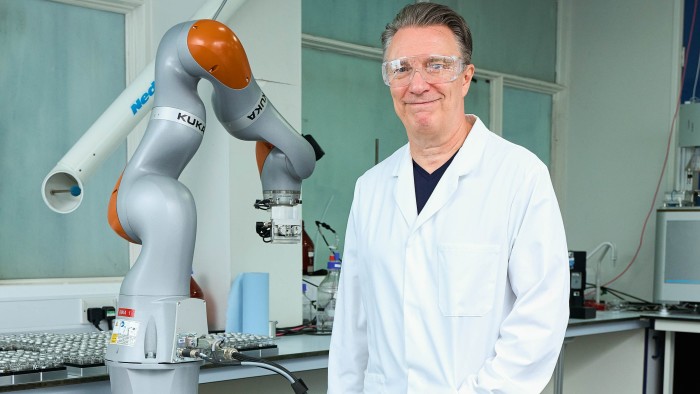
Four 1.75-metres high robots trundle around a chemistry laboratory at Liverpool university, conveying materials between automated workstations where reactions take place and products are analysed. Their movement is dictated by an artificial intelligence system that decides how to proceed as new results emerge — even during the night when no human chemists are present.
Andy Cooper, Liverpool chemistry professor, started to introduce robotics to his lab 10 years ago and published pioneering papers in Nature in 2020 and 2024 that demonstrated how effectively AI-driven robotics can improve productivity. “At three in the morning the robot will have done 50 experiments, it’s got new data and at 3.01am it can decide what to do next while everyone’s asleep,” he says.
The lab robots — adapted, lidar-guided [light detection and ranging] industrial units made by Kuka of Germany — move slowly between automated benchtop reactors and analytical equipment, carrying out experiments in fields from drug discovery to new materials for carbon capture. Sensors enable them to share the space safely with human researchers.
The university announced last month that it would build on the lab’s success to set up a £100mn AI-driven, materials chemistry research hub.
Lee Cronin at Glasgow university is another chemistry professor leading the development of AI-driven robotics in science in the UK, whose spinout Chemify raised $43mn in 2023 and a further $50mn this year.
His ambition is sweeping. “Our vision is that Chemify will be able to design and make any molecule on demand . . . across all of chemistry from drug discovery to new catalysts and electronic materials,” he says. “The next step in our evolution is nothing short of a revolution in the digitisation and automation of chemical discovery and manufacturing.”
The two UK pioneers are taking different approaches. “Mine is to use industrial robots to integrate labs, which I think will prove to be very scalable and may be cheaper,” says Cooper. “Lee is building bespoke facilities which will be needed for some applications. There’s space for both.”
In June, Chemify opened its first Chemifarm, a £12mn fully automated 2,000 sq m facility in Glasgow. “We should be working with 20 partners by this time next year and then we’ll scale up and build Chemifarms around the world,” Cronin says. Beyond the robotic hardware Chemify has developed a programming language called chi-DL which Cronin hopes will become the de facto standard for digital chemistry.
Labs around the world are adopting robotics and AI very fast, according to Cooper. “There are at least 30 to 40 labs using these systems now, and some involve really big investments, particularly in China which is by far the biggest producer of robotics in the world.”
A leading figure in scientific robotics, Sami Haddadin, moved from Technical University of Munich last January to set up a lab at Mohamed bin Zayed University of Artificial Intelligence in Abu Dhabi. He is a proponent of linking AI-driven labs into a collaborative global network that can pool data and computational resources to tackle scientific problems beyond the scope of even the best equipped individual institutions.
Such international collaboration is still in its infancy. To extend it efficiently will require the adoption of standardised data formats, hardware protocols and interoperable software that do not exist today, says Haddadin.
“A network of robotic laboratories around the world will generate far more data than we have seen before, even in particle physics and astrophysics,” he says. “We’ll need infrastructure to make sure the data is analysed and stored . . . and properly distributed with global access.”
Rob Brown, head of the scientific office at Sapio Sciences, the US informatics company, suggests that AI-driven automation will transform research methodology. “Today it’s typically 20 per cent virtual design and 80 per cent doing experiments,” he says. “It’s going to change to perhaps 80 per cent virtual and 20 per cent experimental, though we’ll always need to keep an automated lab in the loop.”
Everyone involved in lab automation insists that AI will augment rather than replace human talent. “Scientists today spend an inordinate amount of time doing things that aren’t productive towards the project’s end goal,” says Brown. “Their role will become more interesting and much more focused on in-depth scientific knowledge and innovation rather than data entry and grunt work in the lab.”
For Cronin, the key human contribution will be creativity. “I have seen no evidence that AIs are at all creative . . . Humans are not going away. They will not have to get their hands dirty and be exposed to toxic chemicals any more but they will remain at the centre of science.”
Cooper sums up this new relationship as “hybrid intelligence”, adding: “Human and artificial intelligence are often set up in opposition to each other but in reality we will want to use human hypotheses and conjecture, as we have always done . . . You can automate reasoning with large language models but it’s relatively shallow reasoning. Human reasoning is deeper but slower and more periodic. The winning proposition is to put the two together.”
Read the full article here