

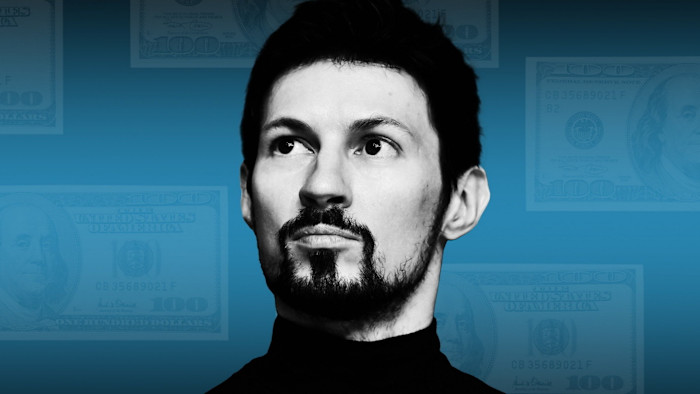
Telegram bonds in Russia worth half a billion dollars have been frozen under western sanctions, revealing the messaging app’s financial exposure to the country even after founder Pavel Durov has sought to sever ties with Moscow.
The company launched a series of bond offerings in recent years, including $1.7bn issued in May, to buy back existing debt. According to people familiar with Telegram’s discussions with investors, it bought back most of the bonds maturing in 2026.
However, the company has said $500mn of outstanding bonds have been immobilised in Russia’s central securities depository due to western sanctions, the people said.
The revelations highlight the extent to which Telegram remains exposed to Russian capital, with the sanctions complicating its debt repayments and buyback opportunities.
EU, US and UK entities all imposed asset freezes and other restrictions on Russia’s National Settlement Depository (NSD) in the wake of Russia’s 2022 invasion of Ukraine — a move that potentially affects any western organisation with Russian bondholders.
However, the asset freeze is particularly jarring for Durov, who has sought to distance himself from his native Russia in recent years, criticising speculation that he is beholden to the Kremlin as “conspiracy theories”. Telegram declined to comment.
The revelations come as Durov explores a potential initial public offering for the company, although those plans have been delayed while he faces legal proceedings in France.
Telegram’s Russia-born owner was hailed the “Mark Zuckerberg of Russia” for co-founding the country’s most popular social media network, VKontakte, in 2007.
The billionaire has said he left in 2014 after refusing to share the data of certain Ukrainian users of VK with Russia’s security agency, selling his VK stake to Kremlin-linked entities under duress.
Around the same time, he founded Telegram, later relocating the group to Dubai, arguing it would be committed to free speech and resist government interference.
The company has told bondholders that it will repay the frozen debt at maturity, with the bonds’ paying agent and depositary then deciding if payment can flow to the Russian holders.
Unlike larger US rivals such as Zuckerberg’s Meta and Elon Musk’s X, Telegram has fewer than 100 full-time staff. It only recently began to make substantial revenues from its 1bn users through advertising and subscriptions.
According to previously unreported half-year disclosures, Telegram had $910mn in cash and cash equivalents at June 30, up from $142mn a year prior.
Durov, who has French and United Arab Emirates citizenship, was placed under formal investigation in Paris in 2024 over the app’s alleged failure to address criminality including child abuse content. Durov has denied any wrongdoing.
Telegram’s bondholders are closely watching the French case for signs it could derail IPO plans drawn up prior to the French legal action.
The company’s recent bond offerings give investors the option to buy shares in any future flotation at a discount of as much as 20 per cent.
Telegram told some bondholders on a recent call that the case needed more resolution before it can proceed with a public market listing, but that it continued to both co-operate with authorities and vigorously contest Durov’s case.
Unaudited financial statements, seen by the Financial Times, show that the messaging app continues to post sales growth despite the ongoing threat to its leadership from the French legal proceedings.
According to the filings, Telegram’s revenues in the first half of 2025 jumped more than 65 per cent to $870mn, compared with $525mn in the same period the previous year.
Nearly a third of Telegram’s revenue — or $300mn — came from so-called exclusivity agreements. The nature of the agreements could not be established but according to FT reporting of previous Telegram earnings, these have been related to toncoin, a cryptocurrency that is closely linked to the messaging app.
Advertising revenue was up 5 per cent to $125mn in the first half of the year. Meanwhile, premium subscriptions jumped 88 per cent to $223mn, compared with $119mn in the same period in 2024 as the number of paying users rose.
The company has told bondholders that it is now on track to hit its financial targets for the full year, according to two people familiar with the matter, implying further growth in the second half of 2025. Telegram aims to book $2bn in revenues in 2025, one of the people said.
Despite achieving an operating profit of nearly $400mn, net losses in the half year were $222mn, compared with a $334mn net profit in the first half of 2024. A person familiar with the matter said this was because the company had to write down the value of its holdings of toncoin, which has steadily fallen in price in 2025 amid a broad crypto market slump.
Toncoin was initially developed in-house at Telegram but is currently developed by an open-source community after the project ran into regulatory troubles with the US Securities and Exchange Commission in 2020.
Since then, Durov has publicly championed the coin, integrating Ton features into Telegram and insisting advertising on Telegram must be paid for using the cryptocurrency. The total value of its digital assets stood at $787mn at the end of June, compared with $1.3bn at the end of June 2024.
Nevertheless, the company told investors on a call in recent weeks that Durov was prioritising improving the Ton ecosystem and further incorporating the crypto into the Telegram platform in 2026.
The company told investors it had sold more than $450mn in toncoin in the year to date. The coin has recently been listed on major exchanges such as Coinbase, Kraken and Gemini.
Read the full article here