

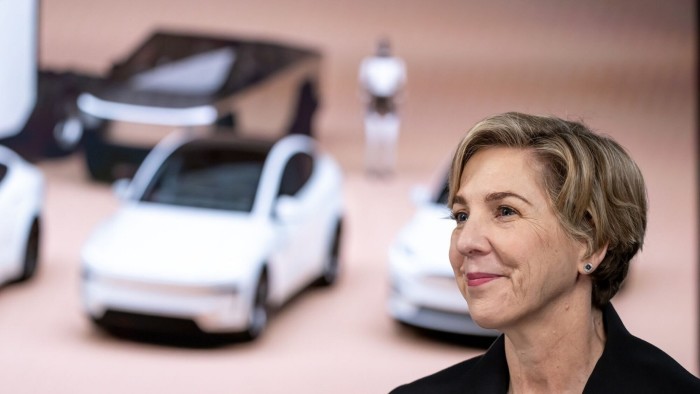
Tesla chair Robyn Denholm has justified her decision to offer Elon Musk $1tn in stock, calling him a “unique” chief executive who must put in superhuman effort and achieve “impossible things” to receive the historic award.
Last week, Tesla’s board proposed a pay package that would grant Musk 12 per cent of the electric-vehicle maker’s shares if over the next decade he can octuple its valuation to $8.5tn, boost earnings 24-fold and sell millions more cars and robots. But achieving even half of the incremental targets could make him the world’s first trillionaire.
“In order to achieve the aspirational goals that we have put in place, he will have to put in time, energy and effort beyond what most humans can do,” Denholm said in an interview with the Financial Times in Palo Alto ahead of a critical shareholder vote on Musk’s pay in November.
“This is definitely not a lay up. It’s a very ambitious plan . . . he earns the right to have an unprecedented award.”
Denholm also defended the board’s hands-off approach to Musk’s divisive politics, emphasising his right to free speech and unique qualities she views as vital to Tesla.
“He’s a generational leader. We think that he actually has what it takes to deliver,” she said. “The board’s opportunity here is to motivate Elon to do impossible things.”
Denholm denied that Musk — the world’s richest man with a $419bn fortune — is motivated by money. She argued the package is structured to offer him incrementally greater control of the company only if he adds trillions in shareholder value, whilst forcing him to wait more than seven years to realise any financial benefit himself.
“He’s been very public about voting rights being important to him. I would say that money is not,” she said. “It’s important to note that he could get nothing . . . zero compensation unless you perform against the milestones.”
Musk has repeatedly threatened to leave if he does not acquire at least a 25 per cent of the stock, arguing he needs a blocking stake to fend off activists as Tesla develops artificial intelligence, self-driving cars and millions of humanoid robots.
Denholm said that she finds his threat credible, and dismissed reports earlier this year that the board sought to replace the CEO as “total rubbish”.
“From my perspective that is a real possibility,” she added. “He has other interests in which he could generate significant advancements in humankind.” Musk also runs $400bn rocket maker SpaceX and $200bn start-up xAI.
The board laid out multiple dire consequences if Musk were to depart: losing his “singular talent” and strategic vision, an exodus of critical staff and a drop in the share price.
Despite this, Denholm denied that Musk represented an “unsustainable” key man risk, giving the board little leverage in contract talks to negotiate the best deal for shareholders.
Without Musk “there are activities in the company that would continue, but our view is the best way to optimise the future of Tesla is with Elon at the helm”.
Despite having one of the most high profile and lucrative roles in technology, Denholm had shunned publicity for most of her six-plus years chairing Tesla from her native Australia. But last year, the 62-year-old former accountant was forced to defend her integrity when a Delaware judge struck down Musk’s 2018 Tesla pay deal.
That too was thought to be unachievable, but paid out in full after Tesla’s value grew from $59bn to exceed $650bn, netting Musk $56bn in stock options.
Denholm has faced fierce personal criticism and found herself at the centre of a debate about the vast wealth and power being accumulated by Silicon Valley’s elite. She herself has made more than $530mn from exercising share options in her 11 years on the board.
In her ruling, the Delaware judge criticised Denholm’s “lackadaisical approach” to governance and characterised the board — which includes Musk’s brother Kimbal, venture capitalist Ira Ehrenpreis, Airbnb co-founder Joe Gebbia and Rupert Murdoch’s son James — as “supine servants of an overweening master”.
Denholm rejected the allegations as “absolute BS” and “crap” in an FT interview last year.
The company is appealing against the decision after the package was re-ratified by a shareholder vote in June last year.
With the case still pending, Tesla last month awarded Musk 96mn shares worth about $30bn in what it described as a “good faith” interim payment. Shareholders will vote on the new 423mn share package on November 6.
Denholm has also been cast in the uncomfortable role of overseeing Musk’s increasingly strident social media posts and navigating the fallout of his relationship, then rift, with President Donald Trump.
Many have blamed his divisive politics for alienating core liberal customers and causing a plunge in car sales in the US and Europe. Second-quarter profit fell by more than a fifth and Tesla now faces the loss of billions in emissions credit trading profit after Republicans neutered US schemes and ended EV tax incentives.
Denholm said that it was “tough to tell” if Musk was the root cause of the sales decline, and that temporarily shuttering four factories to reconfigure them to produce a new version of its bestselling Model Y was also to blame.
“There’s definitely obvious sentiment out there, particularly over the period of time when he was part of the administration . . . But who knows?”
When Musk took a role as head of the so-called Department of Government Efficiency early this year, his cuts to the federal workforce provoked a backlash, with Teslas being vandalised, drivers harassed and dealerships picketed.
“Protests in a democracy are expected, but violent protests, particularly when they’re directed at employees and customers, to me, that’s not cool,” she said.
Investors also criticised the amount of time he spent in Washington away from Tesla’s headquarters in Austin. Denholm said that the company asked him not to travel back and forth for security reasons and that he never disengaged.
“I don’t have to measure the number of hours that he’s working to see what he’s doing at the company,” she said. “Quite frankly, he works extraordinary hours.”
Still, Tesla’s proxy statement ahead of the pay vote said that the board had received “assurances that Musk’s involvement with the political sphere would wind down in a timely manner”.
Denholm declined to comment on whether this meant Musk could no longer start his planned new “America Party” to challenge Trump, donate to candidates in the US or abroad, or continue posting about political issues if he wants to get his shares.
“It’s exactly what it means . . . We spent a long time writing the proxy. The words were very carefully chosen and vetted and gone through 47 advisers. So they are the words that we chose.”
Has she ever asked him to rein in his politics or post less incendiary messages for the benefit of staff and the company’s brand?
“The board is very comfortable having tough conversations,” she said. “I have conversations with Elon regularly. I can text him any time of the day . . . And he will answer me pretty quickly.”
“I don’t call him up about every single tweet that he makes. Free speech is one of his and the US’s important principles . . . At the end of the day he’s an individual. He has opinions. He’s free to share those opinions.”
When asked her view about a post Musk made on September 10 after the assassination of conservative activist Charlie Kirk which stated: “The Left is the party of murder”, she replied: “I don’t think I’m going to comment on that. If there are things that I don’t subscribe to, I will tell him, but not every single tweet.”
Additional reporting by Kana Inagaki and Sujeet Indap
Read the full article here