

Unlock the Editor’s Digest for free
Roula Khalaf, Editor of the FT, selects her favourite stories in this weekly newsletter.
Ukraine is in talks with the US and several Gulf states about replicating Kyiv’s acoustic detection network to counter Iranian attack drones, according to people familiar with the matter.
Ukrainian officials, drone company representatives and a person involved in the talks said discussions are taking place across government, military and private-sector levels. They are looking at how Kyiv’s anti-drone technologies — honed in the four years since Russia’s full-scale invasion — could be adapted for use in the Middle East, as the war in the region enters a second week.
“Americans gave very concrete requests [to Ukraine] — so based on their requests, what they need, we will provide,” the person familiar with the discussions told the FT.
Talks with Gulf countries are more complex, the person added, requiring consultations in the region “to understand what really works”.
The FT first reported on Wednesday that a Gulf government was in talks to buy Ukrainian-made drone interceptors and that Kyiv had begun sharing its experience countering Iranian-made UAVs with partners increasingly concerned about similar threats.
President Volodymyr Zelenskyy said on Thursday that he had “instructed that the necessary resources be provided [to interested parties] and that Ukrainian specialists be present to ensure the necessary security”.
People involved said the talks have since broadened to include other wartime innovations.
Russia has relied heavily on Iranian-designed Shahed drones throughout its full-scale invasion of Ukraine, launching waves of the low-cost weapons at cities and energy infrastructure. In response, the Ukrainian government and military have developed interceptor drones and acoustic drone detection networks such as Sky Fortress.
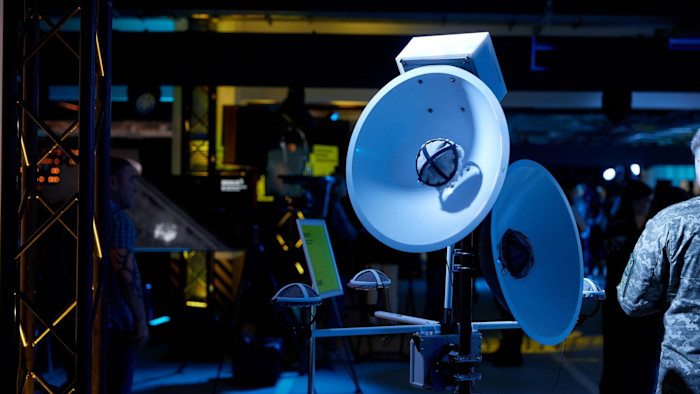
The system was designed in 2022 by two Ukrainian engineers who mounted a microphone and a mobile phone on a pole outside their garage to listen for drones. It has since expanded into a nationwide network of more than 10,000 acoustic sensors that detect Russian drones and quickly relay their location to the military so its air defence forces can shoot them down.
Sky Fortress has proven particularly effective against low-flying Shahed drones that can evade conventional radar, according to people familiar with the technology.
As waves of Iranian Shahed drones have been fired at Gulf countries over the past week, governments in that region now want to replicate the system.
The person familiar with the matter said that Ukraine has been in “constant contact on different levels” with US and Gulf officials, including Ukrainian government and military officials as well as drone company executives.
The Ukrainian defence ministry referred to the president’s office, which did not comment.
The Pentagon referred to the White House, which did not immediately respond to a request for comment.
Ukrainian drone maker SkyFall, which produces one of the most effective drone interceptors, the P1-Sun, told the FT that several Middle East governments have requested its assistance.
“SkyFall is involved in a number of initiatives, however we cannot disclose the details at this time,” the company said. It added that it was working “to help those who need it with our P1-Sun interceptor drones and our practical experience”.
The P1-Sun, a 3-D printed airframe shaped like a bullet and powered by four rotors, can carry up to 500g of explosives at speeds exceeding 310km/h. Over the past three months, P1-Sun interceptors destroyed more than 1,500 Shahed drones and 1,000 other Russian drones, according to SkyFall. Priced at around $1,000 per unit, they have proven a cost-effective air defence solution.
The company offers training to pilots and technicians at the so-called SkyFall Academy, which can also “transfer the necessary knowledge and support the integration of our solutions into the existing systems of other countries”.
General Cherry, another Ukrainian company producing anti-Shahed drones, told the FT that several Gulf countries had expressed interest in their products, with the company now waiting for export authorisations.
“For us it’s important to sell the full solution and not just our product, there’s also our expertise and battle knowledge,” said Marko Kushnir, spokesperson at General Cherry. The company’s flagship anti-Shahed interceptor has been produced since November and has already shot down “hundreds” of the long-range drones, according to Kushnir.
The person familiar with the matter said multiple potential solutions are under discussion with international partners, not only those systems that are already publicly known.
Ukraine is eager to help its partners better combat Shahed drone barrages in return for other types of air defences, notably US-made Patriot systems. Zelenskyy noted on Thursday that more than 800 Patriot interceptor missiles had been launched since Saturday — more than Ukraine has had in four years.
“Our appeal is very simple: we would like to fill our deficit of Patriot missiles and supply a certain number of interceptors,” Zelenskyy said.
Additional reporting by James Politi in Washington
Read the full article here