

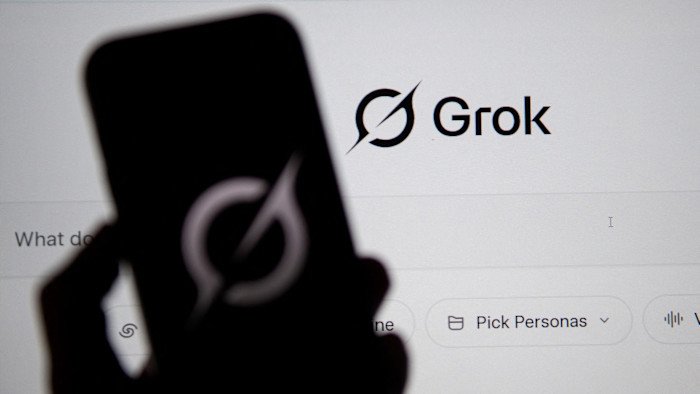
In January, Sweden woke up one morning to find one of its most senior politicians digitally undressed. AI-generated images of Ebba Busch, the Nordic country’s deputy prime minister, began circulating on X after users exploited Elon Musk’s Grok tool to create sexualised versions of publicly available photographs of the 39-year old politician.
The fightback was swift. Busch, leader of the centre-right Christian Democrats, speaking in a video posted to the same platform that pictured her in a bikini, said “the world needs fewer assholes,” and urged users of AI to think about how they use it and what they share.
Swedish politicians, who often pride themselves as a model of gender equality, condemned the episode and warned how easily new technology can be turned against women in public office. Swedish prime minister Ulf Kristersson called the scandal “distasteful, unacceptable, offensive” and “a form of sexualised violence”.
Elsewhere, the European Commission said it was examining potential breaches of its Digital Services Act, and the EU’s tech chief Henna Virkkunen called the episode a “violent, unacceptable form of degradation”.
The UK moved to bring AI tools more clearly within the scope of its Online Safety Act. Prime minister Sir Keir Starmer in February warned tech companies that “no platform gets a free pass” on illegal content as he moved to harden the law to include AI chatbots.
The problem, experts say, is that cases such as Busch’s — as with thousands of women and children targeted by users of AI tools to generate sexualised images — highlight a worsening shift in the architecture of online abuse.
Women in the public eye are particularly affected. As well as politicians, female business leaders are navigating social media at a time when gender-based harassment online, particularly against women in high-profile jobs, is intensifying.
It has become so pervasive, says Susan Watson, professor in criminal justice and social policy at the University of York, in the UK, that some women are abandoning public-facing careers.
“Online abuse is only getting worse for women in occupations that require them to have an online presence, such as politicians, academics or journalists,” she says. The trend for women in senior roles across politics and business to face harassment routinely in public life risks reversing years of progress on gender equality in business and leadership.
Henry Ajder, an independent expert on AI and deepfakes, says nearly all sexual deepfakes target women. In an analysis, done before the Grok scandal, of nearly 15,000 online deepfake videos, he found 96 per cent were pornographic, with women exclusively targeted on dedicated sites.
Starmer has called for a concerted effort to root out online abuse. “In almost every walk of life and certainly in politics but also in the media, or my old profession of law, the abuse of women is always much greater in volume than it is of men,” he told the BBC in February.
Several MPs say “digital resilience” has become part of professional life — from delegating account management to tightening security settings. Some, such as Busch in Sweden, choose strategic visibility and confront the abuse publicly to seize control of the narrative. But others limit engagement or withdraw from some platforms altogether.
Diane Abbott, independent MP for the London constituency of Hackney North and Stoke Newington, receives some of the most racist, sexist and threatening abuse on social media according to Amnesty International. She prevents replies to her posts on X, for example, to help deal with some of the abuse.
Abbott says X is “only getting worse” day by day. “Generally, it has become a pretty unpleasant place. I am on and off considering getting off it.” But X remains a useful communication tool, and she sees no reason why she should be the one forced off by the attacks rather than those responsible for them.
While practical steps — tightening privacy settings and documenting abusive content, as Abbott has done — help reduce personal risk, these measures can only be viewed as interim safeguards, says Dan Mercea, professor of digital and social change at City, University of London. Online abuse requires both stronger platform accountability and regulatory intervention.
In extreme cases, “the systematic and concerted public outcry and threat of stringent regulation seem to have led to self-regulation . . . This is not a task for women only,” he says.
Yet Lillian Edwards, professor of internet law at Newcastle University, in the UK, warns that “practically every AI model can now be adapted to generate nudity images,” referring to tools such as Grok, Midjourney and Stability. “Grok itself is still out there,” she points out, even if users find it harder to post the result immediately.
And ultimately, governments’ attempts to tighten laws may not succeed. For instance, Edwards says, too many of the systems are open source, making a centralised crackdown “near impossible”.
Women in the public eye cannot drop their guard yet.
Read the full article here