

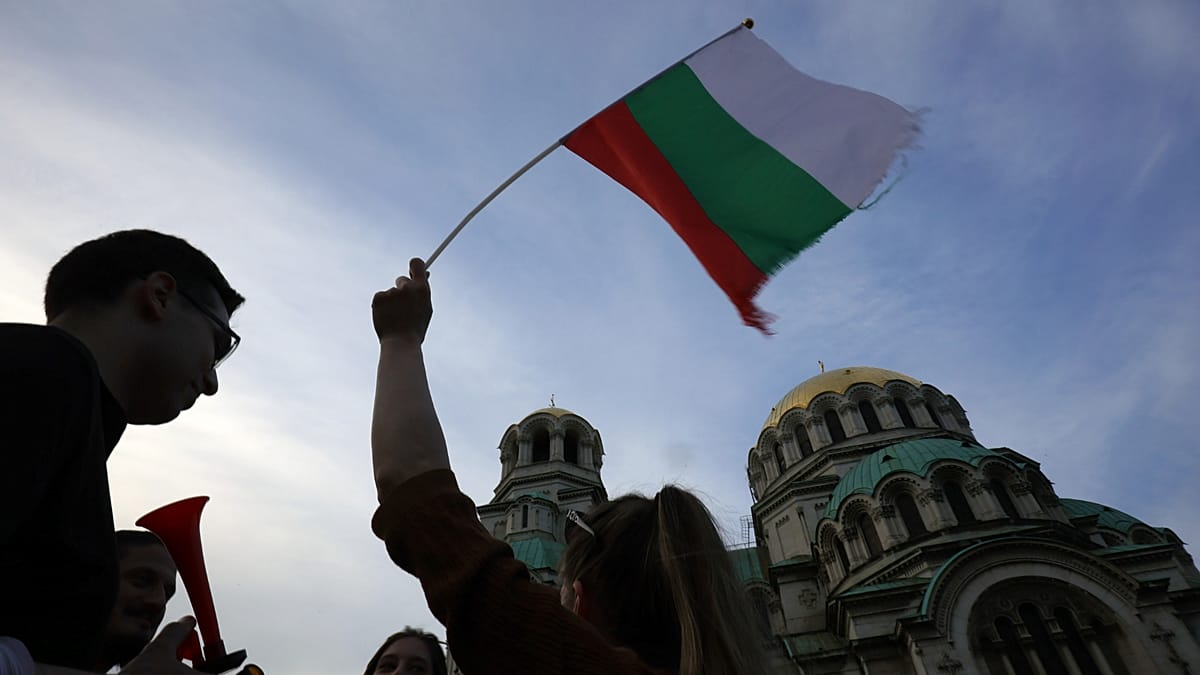
Bulgaria’s snap parliamentary elections on 19 April will mark the country’s eighth election in five years.
ADVERTISEMENT

ADVERTISEMENT
The country’s Moscow-friendly former president, Rumen Radev, from the Progressive Bulgaria party, is currently leading in the polls, ahead of former Prime Minister Boyko Borissov from the conservative centre-right GERB party.
To fight off foreign interference threats, which have become a recurring issue in European elections, Bulgaria’s government has called for assistance from Europe’s diplomatic service, also activating the rapid response system under the Digital Services Act (DSA) — a piece of legislation designed to make the online space safer and more accountable.
The DSA mechanism connects online platforms, civil society, and fact-checkers to identify and restrict content that could interfere in elections.
The Center for the Study of Democracy (CSD), an independent think tank which tracks disinformation operations, stated in March that Bulgaria has “one of the most permissive information environments for non-democratic malign manipulation in the EU and one of the least prepared institutional responses despite continuous progress.”
Bulgaria faced a significant amount of disinformation ahead of its eurozone accession in January 2026. The pro-Russian extremist Vazrazhdane party, also known as Revival, served as one of the principal actors working to spread these misleading narratives.
In February, Revival party members attempted to storm the headquarters of the European Union’s mission in Sofia, as part of a protest against Bulgaria joining the eurozone. European Commission President Ursula von der Leyen labelled the attack “outrageous”.
What misleading claims are taking hold in Bulgaria?
Svetoslav Malinov, analyst at the CSD, told Euronews’ fact-checking team, The Cube, that there has been a spike in disinformation ahead of Bulgaria’s elections.
“Bulgaria is actually not a typical case when you’re talking about disinformation, because it also combines prolonged political instability, weak regulators, and low public trust with a really strong domestic network that spreads and amplifies this type of information,” he said.
When added together, these conditions create fertile ground for disinformation to take hold and spread even on an institutional level, according to Malinov, which becomes especially visible during elections.
“Certain narratives have gained traction, for instance, around election integrity,” he said. “Claims about voting machine hacks and rigging have triggered emergency amendments to the electoral code.”
“Narratives around energy and the euro have also gained explosive new potency, especially since Bulgaria joined the eurozone this year,” Malinov added. “Often the rationale is that because we’re in the eurozone, the energy prices are even worse, and we’re paying even more money.”
Bulgarian websites spread pro-Kremlin narratives
According to the CSD, a number of online outlets are at the centre of operations spreading pro-Kremlin narratives in Bulgaria.
One of these so-called news websites is Pogled Info, a news outlet which repurposes content from sanctioned Russian entities and Chinese state-controlled sources, including Vzglyad, RIA Novosti, Tsargrad TV, and China Radio International.
“This type of infrastructure is like an amplification network where you can trace an article, which has been published in a EU-sanctioned Russian outlet, which is then republished and stripped. The author’s name is removed and republished on Poglet”, said Malinov.
“The claims from these articles are picked up within minutes on social media, often by accounts who are pro-Russian status,” he added.
Read the full article here